
 But still no major technology insertions coming from the big companies...
So the question remains: Are interactive-textile technologies doomed to remain confined to SkyMall or will they actually find their way to be adopted by more established companies?
Saturday, January 26, 2008
The OR Show recap
It was truly exciting and there was lots of technology to see -- unfortunately there was very little in the way of "interactive" textiles. There was a good deal of heating applications in apparel with a number of companies such as Mountain Hardwear, Outdoor Research hinting at using the technology as well as a handful of less-technical products that used the technology for novelty purposes.

Friday, January 4, 2008
Winter OR Show
I am heading to the Winter OR Show this month (January 23rd - 25th in Salt Lake City) and I'm looking forward to seeing some new technologies hitting the market. Hopefully we'll see something beyond the standard "ipod" or "MP3 jacket" type of product.

This winter season is expected to have more interactive textiles than the summer show, but we'll have to wait and see. For a look back at the sparse "summer market" OR Show, visit my August review. Stay tuned...
This winter season is expected to have more interactive textiles than the summer show, but we'll have to wait and see. For a look back at the sparse "summer market" OR Show, visit my August review. Stay tuned...
Tuesday, December 18, 2007
"Did You Know..."
I realize this isn't necessarily about Interactive Textiles, but it is something worth looking at nonetheless.
Thanks to Winston for pointing it out (this is version 2.0 by the way)...
Thanks to Winston for pointing it out (this is version 2.0 by the way)...
Monday, December 17, 2007
Nanotextiles & Intelligent Textiles
I was in Prague last week for the Nanotextiles and Smart/Intelligent Textiles conferences. As was expected, the people I met there was certainly worth more to me than seeing the actual talks. Also, cheers to Pira-Intertech for doing a great job running the event -- I was more than skeptical but I was pleasantly surprised at the attendees and the talks.
 Hopefully the SmartFabrics conference in Charleston, SC will live continue to live up to its high expectations. More to come on the Prague talks...
Saturday, December 8, 2007
Flexible Electronics and Interative Textiles
Flexible Electronics -- probably as ambiguous as "interactive-textiles" or "intelligent textiles" or any other buzz word of the day. But did you know that this industry is not only solving the hard problems that can enable interactive textile applications, but that they're gaining the momentum of a multi-billion dollar industry? How you ask? They're riding the coat-tails of the display industry. Big-screen flat panel LCD TV's are becoming cheaper because the industry learning how to process large areas more effectively (the bloated costs of yesterday are primarily an artifact of poor yeild on the line). 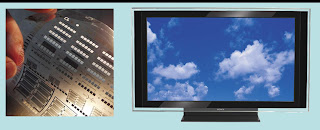 So then you could ask "well if the interactive textiles industry is following the trails blazed by the wildly popular ipod, why is it so much smaller and less popular?" There are several answers but essentially it boils down to the market dynamics behind the ipod. Yes the ipod is popular, but it was developed privately by one company. TV's are commoditized and the display industry as a whole is open with government funded consortiums. With time the interactive textiles industry could grow at rates that rival the display industry, but maybe the application space needs to expand beyond the ipod or iphone.
So then you could ask "well if the interactive textiles industry is following the trails blazed by the wildly popular ipod, why is it so much smaller and less popular?" There are several answers but essentially it boils down to the market dynamics behind the ipod. Yes the ipod is popular, but it was developed privately by one company. TV's are commoditized and the display industry as a whole is open with government funded consortiums. With time the interactive textiles industry could grow at rates that rival the display industry, but maybe the application space needs to expand beyond the ipod or iphone. That notion aside, let's talk about why flexible electronics is vitally important to interactive-textiles as a whole. The primary reason is the advantage that flexible electronics can provide from an integration perspective. Integrating electronics into textiles is difficult enough but having to use standard bulky electronics (and packaging) can reduce the flexibility and x-factor of "feel" in the final products. Secondly, as flexible electronics matures, the roll-to-roll paradigm becomes more realistic. In the roll-to-roll paradigm, interactive-textiles can now be realized through making the textiles the host substrate. We're really only skimming the surface of what's possible, what do you think?
Thursday, November 1, 2007
Aussies funding Energy Shirt
The Commonwealth Scientific and Industrial Research Organisation (CSIRO) in Australia going to be putting some big money toward a shirt for soldiers to wear that will scavenge and store energy.

It is good to see some federally funded efforts again, hopefully they'll have more success than we did here in the states. But it looks like what they're doing is a new direction that what's been done in the past decade -- that's generating/scavenging energy and then storing it on the body.

It will be interesting to see how efficiently the transducers will be able scavenge energy from the soldier's movement -- we probably all remember the whole "heel-strike PZT" debacle from a few years ago. 
But I think there is reason to be optimistic; new nanotechnology is enabling scavenging with nanowires that may prove to offer a more efficient means of drawing power (if it can be scaled). Let's just hope that at the end of the day it actually decreases the amount of weight these soldier's have to carry -- not just distribute the load...
Sunday, October 28, 2007
Virus Extrusion
If you haven't read the article on Angela Belcher's work at MIT, please read it here. Since I know a lot of attention is being paid to photonic textiles these days, this technology could be especially useful. The basic idea is this: quantum dots are functionalized to attach themselves to virus strands at strategic locations and the mixture is extruded into solution (very similar to wet spinning). Quantum dots can do several cool things (see below) - but that's not the point. The point is that these guys have enabled self-assembly on the molecular level that exceeds what can currently be done through polymerization.
The applications listed in the write-up are the usual suspects or fiber batteries and solar cells, but there is so much more that could be done. Scalability will certainly be an interesting challenge. What are some other functional components that could be used with the virus assembly method?
 The resulting fiber is analogous in tensile strength to nylon which means that it could be possibly spun and woven/knitted.

The applications listed in the write-up are the usual suspects or fiber batteries and solar cells, but there is so much more that could be done. Scalability will certainly be an interesting challenge. What are some other functional components that could be used with the virus assembly method?
Subscribe to:
Posts (Atom)